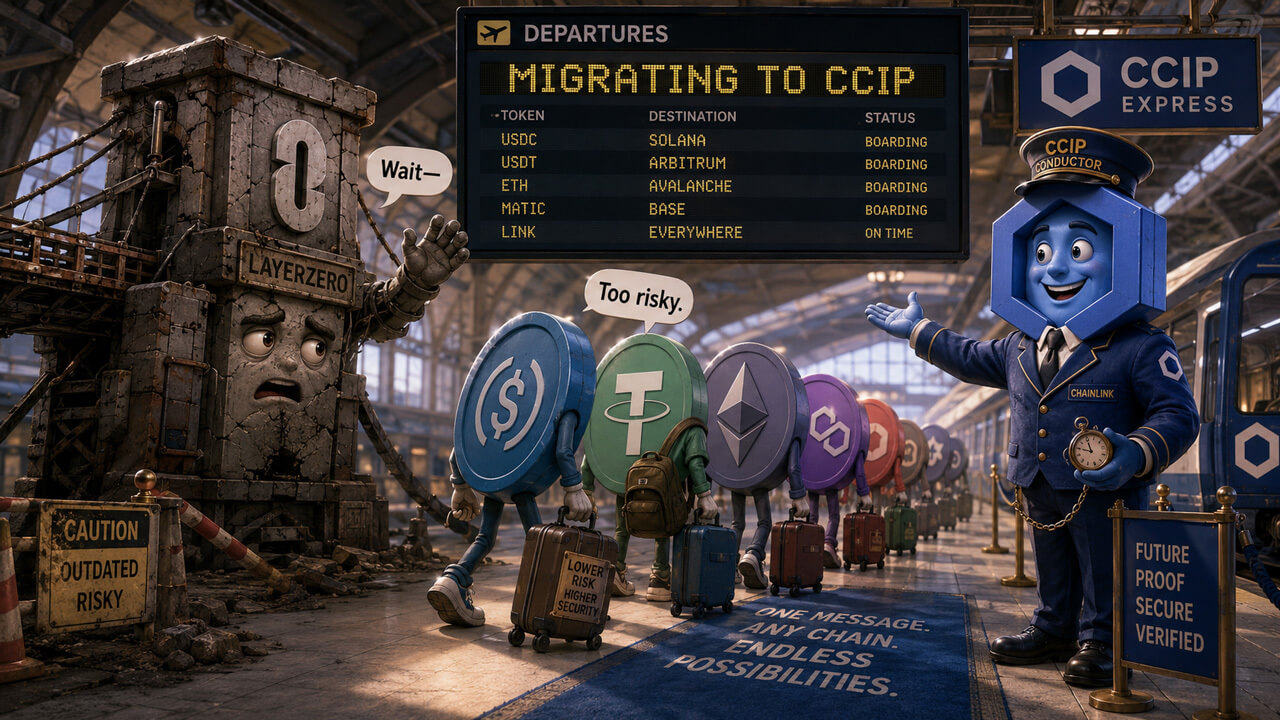
**What happened:** Four major DeFi protocols controlling over $3 billion in total value locked have migrated from LayerZero to Chainlink's Cross-Chain Interoperability Protocol (CCIP) following KelpDAO's $292 million exploit. The migration wave includes KelpDAO itself, plus Solv Protocol, Re, and Tydro, marking a significant infrastructure shift in cross-chain DeFi operations.
**Why it matters:** This mass migration represents a decisive market response to bridge security vulnerabilities, with protocols prioritizing battle-tested infrastructure over newer alternatives. The move validates Chainlink's enterprise-grade approach to cross-chain communications and potentially reshapes competitive dynamics in the interoperability space. For institutional investors, this signals a flight-to-quality trend that could influence broader DeFi adoption patterns and risk assessment frameworks.
**Context:** Bridge exploits have plagued DeFi throughout 2023-2024, with over $2 billion lost across various protocols. The KelpDAO incident appears to have triggered a broader reassessment of cross-chain infrastructure choices, particularly around LayerZero, which had gained significant traction among newer protocols. As crypto regulation news 2026 continues to evolve with stricter compliance requirements, protocols are increasingly gravitating toward proven infrastructure providers with stronger security track records.
• **Additional LayerZero migrations** — whether more protocols follow suit amid regulatory pressure and security concerns
• **Chainlink's market positioning** — how CCIP leverages this momentum to capture enterprise and institutional cross-chain adoption
This infrastructure consolidation reflects the maturing DeFi landscape, where security and reliability increasingly trump innovation speed in protocol selection decisions.
#ChainlinkCCIP #DeFiBridges #CrossChainSecurity